Last updated: 19.11.2026
Long before Nicolaus Copernicus recorded his revolutionary calculations in Warmia, he spent the first 18 years of his life in bustling, merchant-run Toruń. Watching river barges dock along the Vistula, listening to Hanseatic traders, and learning his first Latin letters beside the Gothic cathedral sparked the restless curiosity that would reshape humanity’s view of the cosmos.
Jump straight to any stop below or simply scroll through — the trail tracker on the right follows your progress along the way:
Born in Toruń: Who Were Copernicus’s Parents & Where Did He Grow Up?
Nicolaus Copernicus was born in Toruń on February 19, 1473. Thanks to a surviving 16th-century horoscope cast for the astronomer, we even know the exact time recorded for his birth: 4:48 PM! He was born into a wealthy, respected burgher family:
- Father — Nicolaus Copernicus the Elder: A wholesale merchant trading in Hungarian copper and fine cloth who moved permanently from Kraków to Toruń around 1458. He quickly won the town’s trust and became a lay judge of the Old Town court in 1465.
- Mother — Barbara Watzenrode: Came from one of the richest and most influential patrician families in Toruń, closely connected to the urban elites of Gdańsk, Elbląg, and Chełmno.
- Siblings: Nicolaus was the youngest of four children. He had an older brother, Andrzej (who later studied alongside him in Kraków and Italy), and two sisters: Barbara (who entered a convent in nearby Chełmno and rose to become abbess) and Katarzyna (who married local merchant Bartłomiej Gertner).
The Mystery of Two Houses: Old Town Square 36 or ul. Kopernika 17?
Walking around the Old Town reveals one of Toruń’s neatest historical puzzles. In 1473, when
Nicolaus was born, his parents owned two townhouses in Toruń:
• The first was the prestigious “Glazurowa” (Glazed) Townhouse at Old Town Market Square 36 (on the
northern edge of the square, between Chełmińska and Szczytna Streets — marked today by a
commemorative plaque on the former department store building). Historians from Nicolaus
Copernicus University conclude that Nicolaus was most likely born here and spent his first
seven years on the square!
• The second was the Gothic house at today’s ul. Mikołaja Kopernika 17
(formerly St. Anne’s Street). When Copernicus’s father sold the Market Square property in
1480, the family moved to St. Anne’s Street — where the modern Nicolaus Copernicus House museum stands today.
Copernicus’s Baptismal Font in St. John’s Cathedral: A Genuine Relic of 1473
If you want to stand beside an authentic object tied directly to Nicolaus Copernicus’s first days of life, head straight to the soaring Brick Gothic church near the river — the Cathedral of SS. John the Baptist and John the Evangelist on Żeglarska Street. In the Middle Ages, this was Toruń Old Town’s main parish church.
In the westernmost chapel of the south side aisle (right beside the massive tower) lies the Copernicus Chapel (formerly dedicated to the Guardian Angels). Inside wait three extraordinary treasures:
- Original 13th-century baptismal font: A cast-bronze Gothic basin dating from around 1270, topped with a carved 18th-century wooden lid. It was right at this font in February 1473 that baby Nicolaus was held up for baptism!
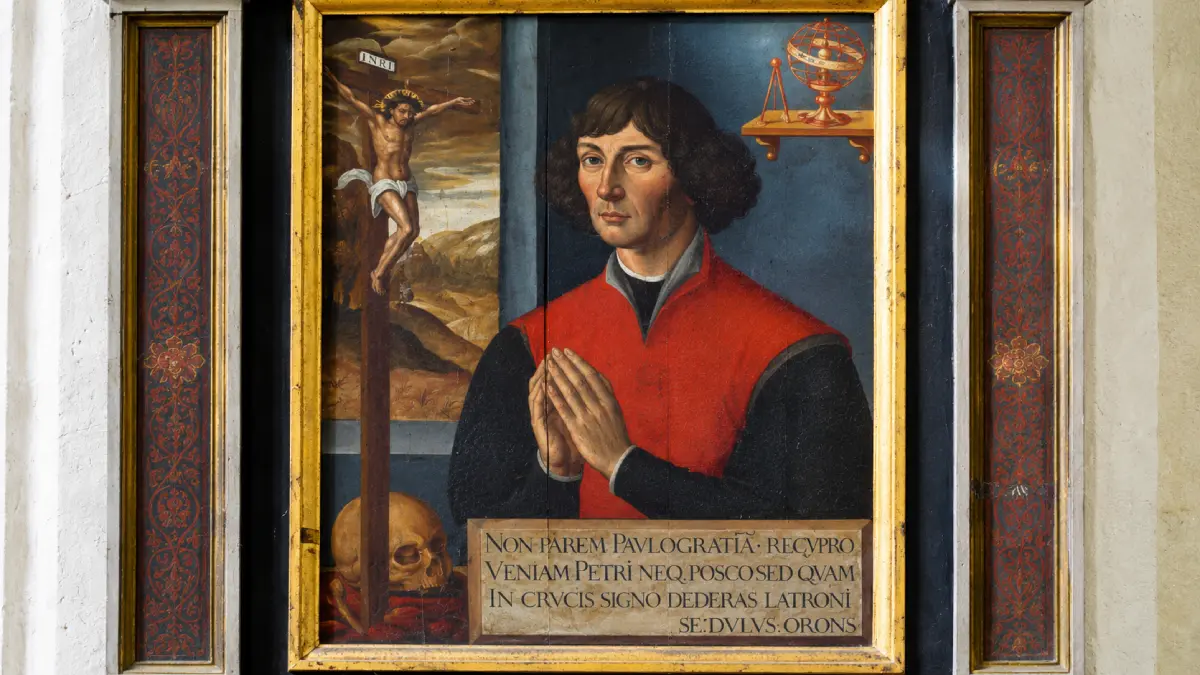
- Renaissance epitaph portrait (ca. 1580–1589): Hanging directly above the font is an epitaph funded by Toruń physician and humanist Dr. Melchior Pirnesius, featuring one of the oldest surviving painted portraits of Copernicus with his hands folded in prayer.
- Oldest bust of Copernicus in Poland (1766): Right beside it stands a marble bust commissioned in 1766 by Prince Józef Aleksander Jabłonowski and carved by Kraków sculptor Wojciech Rojowski (ceremonially installed in the cathedral in 1809).
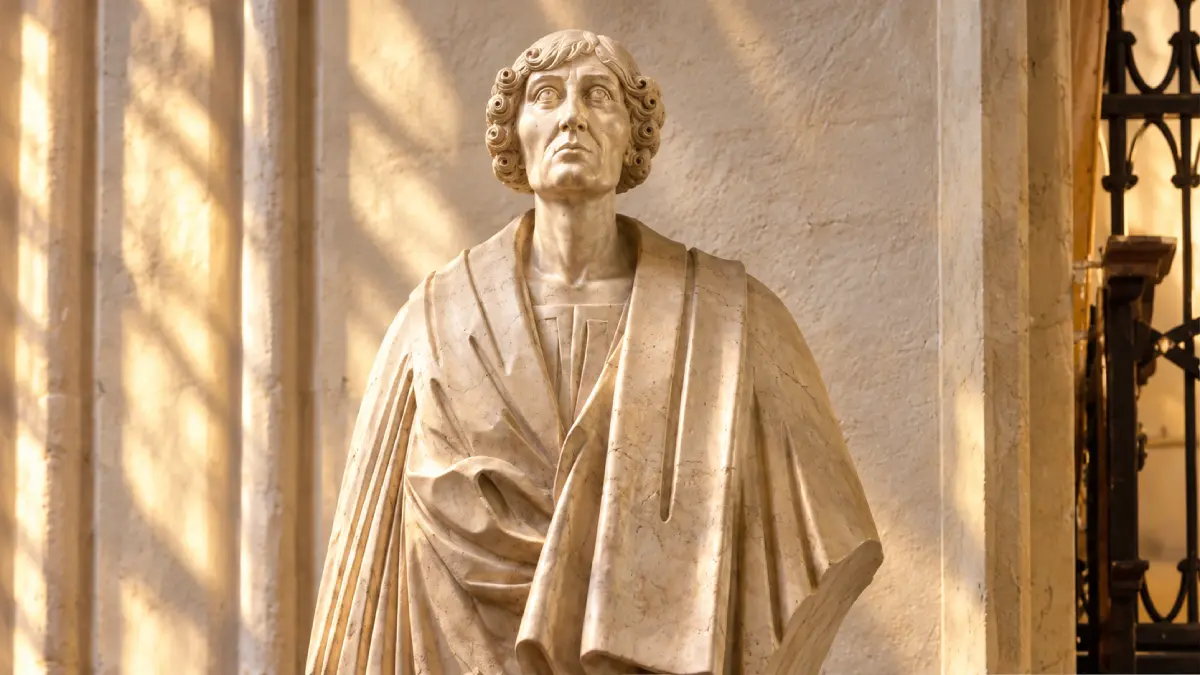
🔔 Local’s tip: While visiting St. John’s Cathedral, glance up toward the mighty bell tower. In 1500, Poland’s largest medieval bell was hung there — the famous “Tuba Dei” (Trumpet of God), weighing over 7.2 metric tons. When Copernicus visited his hometown as an adult (including in June 1504 during a royal assembly with King Alexander Jagiellon), he heard the exact same deep chime that rings out over Toruń on major feast days today!
Nicolaus Copernicus House & Kopernika Street: A Gothic Time Machine
Step out the northern side of St. John’s Cathedral and you immediately find yourself on one of Toruń’s most atmospheric lanes — ul. Mikołaja Kopernika. In medieval times it consisted of two distinct streets split by Ducha Świętego Street: the eastern section hugging the cathedral was known as School Street or Priests’ Street (at today’s No. 4 stood the parish school young Nicolaus attended!), while the western stretch leading toward the medieval defensive walls and Leaning Tower was called St. Anne’s Street. In the late 19th century both sections were unified under the astronomer’s name. Today this cobbled lane delights visitors with restored Gothic facades, cosy cafés, and traditional Toruń gingerbread shops.
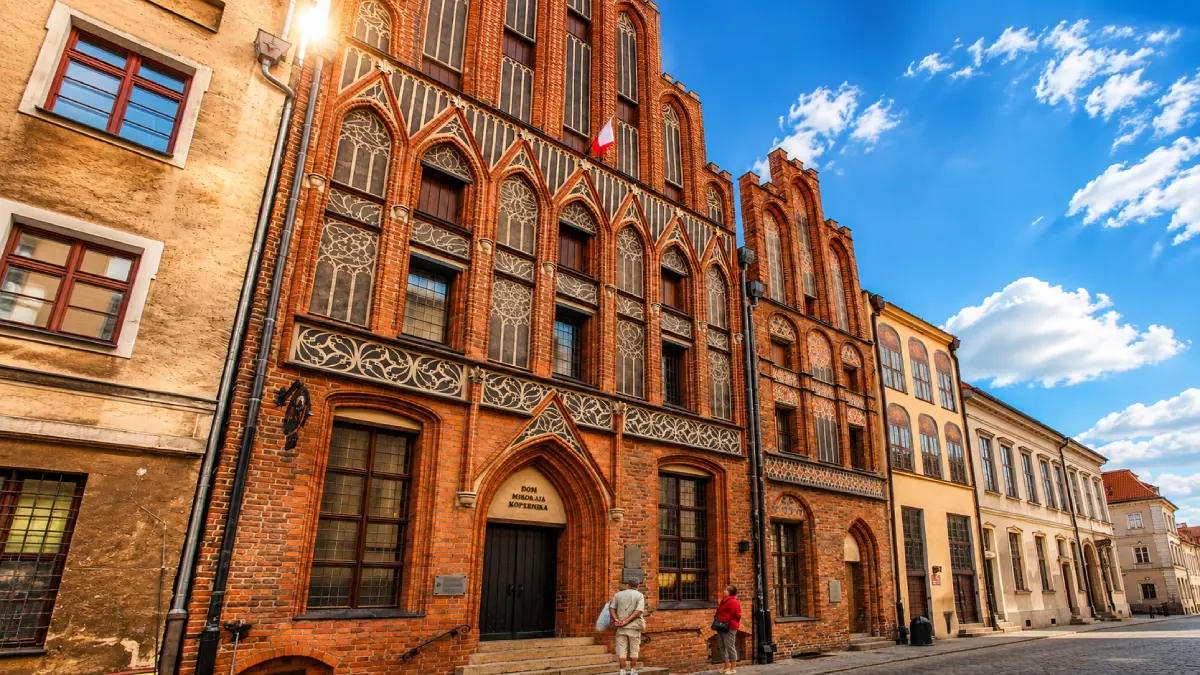
At ul. Kopernika 15/17 stand two soaring, connected red-brick townhouses housing the interactive Nicolaus Copernicus House (a branch of the District Museum in Toruń). Curiously, for over a century people believed house No. 15 belonged to his family — until historians examined medieval tax registers and proved the Copernicus family actually owned house No. 17! Today you tour the combined interiors of both buildings:
Gothic Merchant House Interiors
See how a wealthy Toruń merchant family actually lived 550 years ago: walk through the tall entrance hall with its vaulted kitchen, spot the father’s wooden merchant counting office, explore historic living rooms, and watch a light-mapped scale model of 15th-century Toruń.
Glass Floors, 4D Cinema & Medieval Timber Roof
In the cellars, walk across glass floors suspended over Toruń’s oldest 13th-century foundations and catch a short 4D film. Upstairs beneath the original medieval roof beams, explore period astronomical instruments and the science behind the Copernican Revolution.
Want to pair Copernicus House with other nearby stops? See our full Practical Toruń Travel Guide & Walking Loop or browse all 42 Top Attractions in Toruń.
His Academic Journey: How a Boy From Toruń Studied Across Europe
Nicolaus Copernicus wasn’t just an astronomer — in modern terms he held multiple disciplines under his belt: mathematician, canon lawyer, physician, economist, cartographer, and literary translator! When his father died in 1483, his mother’s brother — Uncle Lucas Watzenrode (a scholar educated in Kraków, Cologne, and Bologna who became Bishop of Warmia in 1489) — stepped in as guardian of 10-year-old Nicolaus and his siblings, making sure his gifted nephew reached the finest universities in Poland and Renaissance Italy.
Nicolaus Copernicus’s Education Step by Step
First Schooling Beside Toruń’s Cathedral
Around age seven, Nicolaus enters the highly regarded parish school at St. John’s Church in Toruń (located right beside the cathedral on old School Street — today’s ul. Kopernika 4). Here he masters fluent Latin (the universal language of European scholarship), arithmetic, rhetoric, choir singing, and the basics of astronomy and geography.
Astronomy & Mathematics in Poland’s Royal Capital
In autumn 1491, 18-year-old Nicolaus and his brother Andrzej enrol in the Faculty of Liberal Arts at the Kraków Academy (today’s Jagiellonian University), registered in the matriculation book as “Nicolaus Nicolai de Thuronia solvit totum” (“Nicolaus, son of Nicolaus from Toruń — paid tuition in full”). Kraków was celebrated across Europe for its astronomy and mathematics faculty. Here young Copernicus buys his first astronomical tables and begins spotting troubling flaws in ancient models of the universe.
Law Studies in Italy & a Breakthrough Observation
At his uncle’s urging, Nicolaus crosses the Alps to Europe’s oldest university in Bologna to study canon and civil law (and begins learning Ancient Greek). After lectures, his eyes stay glued to the sky as assistant to famed Italian astronomer Domenico Maria Novara. On March 9, 1497, they jointly observe the Moon occulting the bright star Aldebaran — a measurement proving to Copernicus that Ptolemy’s ancient model miscalculated the Moon’s distance from Earth.
Medical School in Padua & Doctorate in Ferrara
After spending the 1500 Jubilee Year in Rome (gaining legal experience at the Roman Curia and observing a lunar eclipse) and briefly returning to Warmia, Copernicus spends two years studying medicine and Greek in Padua — training that would make him a respected physician in Warmia for decades. Twelve years of university study culminate on May 31, 1503, when Copernicus earns his Doctorate in Canon Law at the University of Ferrara (chosen for its lower graduation fees than Bologna) before returning home.
His Life’s Work Made Simple: How Copernicus “Stopped the Sun and Moved the Earth”
Back in Poland, Copernicus settled in Warmia (living in Lidzbark Warmiński, Olsztyn, and Frombork). As a canon of the Warmia Cathedral Chapter, he managed estates, treated patients, and wrote monetary reform treatises — independently formulating the economic principle known today as the Copernicus–Gresham Law (“bad money drives out good”). In 1520–1521 he even organised the successful defence of Olsztyn Castle against Teutonic Knights. All the while, by night and day, he kept observing the sky with handcrafted instruments.
What exactly was the revolution he distilled after nearly thirty years of calculations in his six-book masterpiece De revolutionibus orbium coelestium (“On the Revolutions of the Heavenly Spheres”), printed in Nuremberg in 1543 with the help of his sole disciple Georg Joachim Rheticus — arriving just before Copernicus’s death on May 24, 1543?
- Before Copernicus (Geocentrism): For roughly 1,500 years, people believed Earth sat fixed at the centre of the universe while the Sun, Moon, and every planet revolved around us.
- What Copernicus Proved (Heliocentrism): Using geometry and mathematics, Toruń’s scholar demonstrated that Earth is not the stationary centre of creation, but a planet in triple motion: spinning once a day on its axis (creating day and night), orbiting the central Sun once a year, and maintaining a steady axial tilt in space (explaining the seasons and the slow precession of the equinoxes).
- Why It Changed Everything: Copernicus’s breakthrough ignited the Scientific Revolution — paving the way for Galileo, Johannes Kepler, Isaac Newton, and ultimately modern space exploration. Want to see the Solar System come alive overhead? Don’t miss the Władysław Dziewulski Planetarium on Franciszkańska Street!
The Copernicus Monument in Toruń: Why Locals Call It “Kopiec”

When a Toruń local says, “Let’s meet at five by Kopiec,” everyone knows they mean the Nicolaus Copernicus Monument standing at the south-east corner of the Old Town Market Square right beside the Old Town Hall tower.
The first push to erect a statue in his hometown came back in 1809 from Stanisław Staszic (who even laid a cornerstone), though after Toruń returned to Prussian rule, fundraising stretched over four decades. Designed by Berlin sculptor Friedrich Tieck, the bronze monument was finally unveiled on October 25, 1853. Look closely when you stop here:
- Armillary Sphere & Skyward Finger: Standing 2.6 metres tall in bronze, Copernicus holds a spherical astrolabe in his left hand while pointing upward toward the heavens with his right.
- The Famous Latin Inscription: Golden letters on the granite pedestal declare: “Nicolaus Copernicus Thorunensis. Terrae motor, Solis Caelique stator” — meaning “Nicolaus Copernicus of Toruń. Mover of the Earth, Stopper of the Sun and Heavens.”
- A Second Monument — “Helios” at Plac Rapackiego: Strolling west from the Old Town along al. św. Jana Pawła II, look out for the modernist “Helios” sculpture by Józef Kopczyński, unveiled in 1973 to celebrate the 500th anniversary of Copernicus’s birth.
Cosmopolis Fountain: Walk Across a Diagram From Copernicus’s Manuscript
Just a few dozen steps north of the “Helios” sculpture — where Fosa Staromiejska meets al. św. Jana Pawła II on Lucjan Broniewicz Square (named after the longtime director of the Toruń Planetarium) — sits one of Poland’s most imaginative tributes to Copernicus: the Cosmopolis Fountain, opened in 2008 and designed by artist Zbigniew Mikielewicz.
Step onto its granite slab and you realise it isn’t an ordinary city fountain, but an exact stone engraving of the heliocentric diagram straight from Copernicus’s De revolutionibus! Concentric rings carry the original Latin labels from his manuscript marking each planet’s orbit — from Mercury, Venus, and Earth with the Moon out to Mars, Jupiter, Saturn, and the sphere of fixed stars.
⛲ How does the “water Solar System” work? Hidden flush in the granite are 113 water jets. The central jet symbolises the Sun (Sol), shooting up to 5 metres high, while the other 112 trace the planetary orbits. By day it’s a magnet for laughing kids; on summer evenings (May to October), free light, water, and music shows play to the sweeping piece “Cosmopolis” composed specially for Toruń by Krzesimir Dębski and recorded with the Toruń Symphony Orchestra!
Paintings & Portraits: What Did Nicolaus Copernicus Really Look Like?
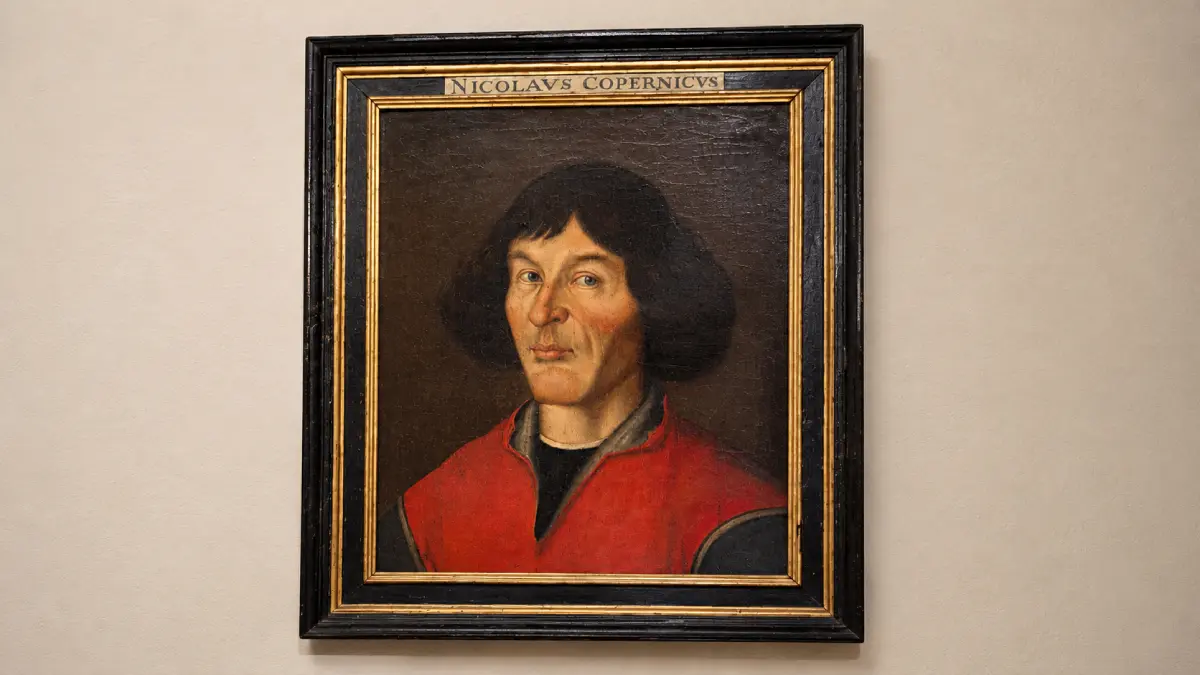
Everyone recognises Copernicus’s face instantly: elongated features, piercing dark eyes, and thick shoulder-length hair. Yet few visitors realise that the two most valuable Renaissance portraits of the astronomer are preserved right here in Toruń! Here is where to see them in person:
1. The Famous “Toruń Portrait” (Gymnasium Portrait)
In the Burghers’ Hall of the Old Town Hall (District Museum in Toruń), you can view the priceless original painted on an oak panel around 1580–1585 for Toruń’s Academic Gymnasium (founded 1568). Scholars believe it was copied from a lost self-portrait painted by Copernicus himself! Later artists — including Jan Matejko — modelled Copernicus’s famous likeness on this very painting.
2. The Copernicus Epitaph Portrait
Toruń’s second authentic 16th-century portrait hangs inside St. John’s Cathedral right above his baptismal font. Commissioned by Toruń physician Dr. Melchior Pirnesius (d. 1589), it honours Copernicus with folded hands both as a brilliant astronomer and as a devoted doctor.
Nicolaus Copernicus University (NCU) & Piwnice Observatory: A Living Legacy
Toruń’s grandest living monument to the astronomer is Nicolaus Copernicus University (NCU / UMK), founded in 1945 — which still celebrates its annual University Day on February 19, Copernicus’s birthday! Established right after World War II largely by scholars arriving from Stefan Batory University in Vilnius (including the pioneers of Toruń astronomy, Prof. Władysław Dziewulski and Prof. Wilhelmina Iwanowska), NCU is today one of Poland’s leading research universities.
-
Bielany Campus & Stefan Knapp’s Mural (ul. Gagarina): Built between 1967 and
1973 for the 500th anniversary of Copernicus’s birth by architect Ryszard Karłowicz’s team, the
campus is a listed jewel of Polish modernism. Don’t miss the front facade of the NCU Main
Auditorium (Aula UMK) — adorned with a vibrant monumental mural of 255
porcelain-and-glass-enamelled steel panels by artist Stefan Knapp, depicting celestial
bodies, Copernicus’s portrait, and a sundial!
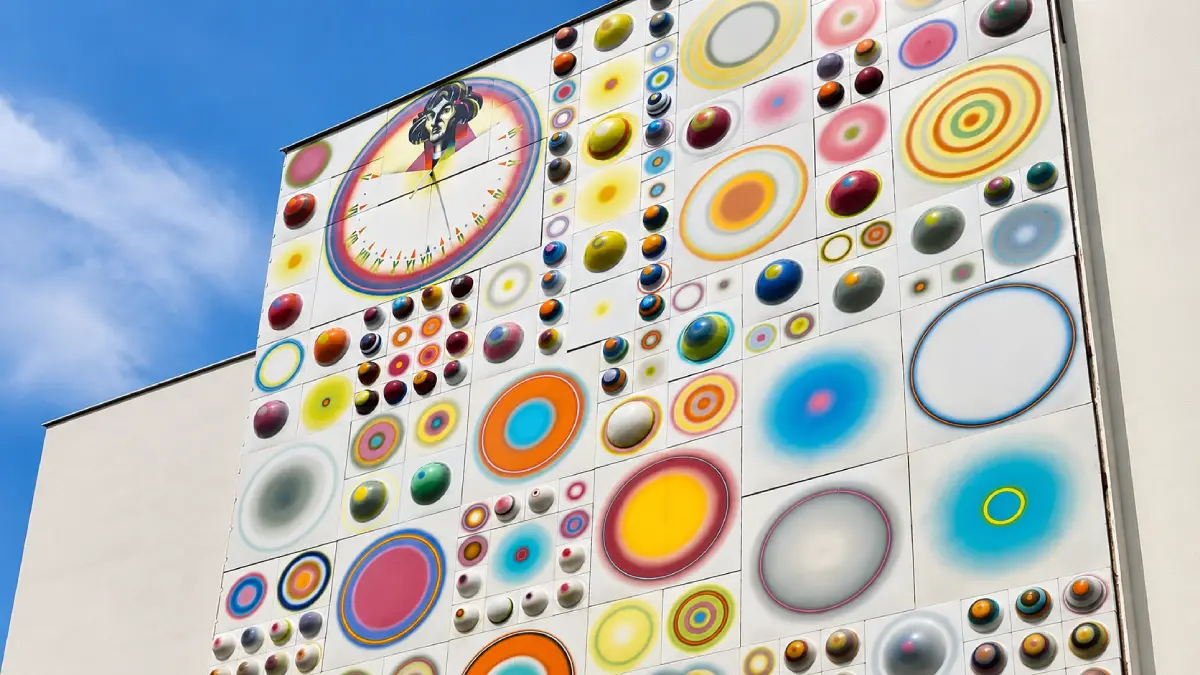
Facade of the NCU Main Auditorium (Aula UMK) in Toruń featuring Stefan Knapp’s famous enamel mural (author’s photo) - NCU Astronomical Observatory in Piwnice: Just 13 kilometres north of central Toruń in a historic manor park operates the university’s renowned astronomy institute — alma mater and research home of Prof. Aleksander Wolszczan, co-discoverer of the very first confirmed exoplanets outside our Solar System! Its landmarks include the towering 32-metre RT4 radio telescope (the largest in Poland and Central-Eastern Europe) and Poland’s largest optical telescope (90 cm mirror). Guided tours are available by prior reservation.
How to Plan a 2-Hour Copernicus Walk Through Toruń Old Town
Every major Copernicus landmark in central Toruń sits just minutes apart! Start beneath the Copernicus Monument on the Old Town Market Square, glance across at Old Town Market Square 36, step into the Old Town Hall to see the original Toruń Portrait, walk down to St. John’s Cathedral (baptismal font & epitaph), stroll along ul. Kopernika to Nicolaus Copernicus House (No. 15/17), and cap it off with a star show under the dome of the Planetarium on Franciszkańska Street!
Frequently Asked Questions About Nicolaus Copernicus in Toruń (FAQ)
When and where exactly was Nicolaus Copernicus born?
Nicolaus Copernicus was born on February 19, 1473 in Toruń as the fourth and youngest child of wholesale merchant Nicolaus Copernicus the Elder and Barbara Watzenrode. At the time of his birth, his parents owned two houses in Toruń: a grand patrician townhouse at Old Town Market Square 36 (on the northern side between Chełmińska and Szczytna Streets), where recent historical research suggests he was most likely born and lived until 1480, and the Gothic house at today’s ul. Mikołaja Kopernika 17 (formerly St. Anne’s Street), now home to the Nicolaus Copernicus House museum.
Where in Toruń was Nicolaus Copernicus baptised?
The future astronomer was baptised in the Old Town’s main parish church — today’s Cathedral of SS. John the Baptist and John the Evangelist on Żeglarska Street. Inside the Copernicus Chapel (south side aisle near the tower), the original 13th-century bronze baptismal font used for baby Nicolaus’s christening in 1473 still stands today.
Where did Nicolaus Copernicus study?
He began his education around 1480 at the St. John’s parish school in Toruń. From 1491 to 1495 he studied the liberal arts (including astronomy and mathematics) at the Kraków Academy (today’s Jagiellonian University). He then travelled to Italy: from 1496 he studied law in Bologna (with legal practice in Rome in 1500), from 1501 to 1503 he studied medicine and Greek in Padua, and on May 31, 1503 he earned his Doctorate in Canon Law at the University of Ferrara.
What did Copernicus prove in “On the Revolutions of the Heavenly Spheres”?
For nearly 1,500 years before Copernicus, scholars believed that the Earth sat motionless at the centre of the universe while the Sun and stars revolved around it. In his landmark book De revolutionibus orbium coelestium (printed in Nuremberg in 1543), Copernicus used mathematics and decades of sky observations to show that Earth — together with the other planets — orbits the Sun (the heliocentric model) while spinning on its own axis.
Where in Toruń can you see the most famous portraits of Copernicus?
The most valuable original 16th-century painting — the famous “Toruń Portrait” painted on an oak panel for the old Academic Gymnasium — is on display inside the Old Town Hall. A second priceless period painting, a Renaissance epitaph portrait commissioned before 1589 by local physician Dr. Melchior Pirnesius, hangs directly above the baptismal font in St. John’s Cathedral.
What does the Latin inscription on the Copernicus Monument mean?
The gold Latin inscription on the pedestal of the 1853 monument reads: “Nicolaus Copernicus Thorunensis. Terrae motor, Solis Caelique stator”, which translates to: “Nicolaus Copernicus of Toruń. Mover of the Earth, Stopper of the Sun and Heavens.”